Billionaires Bankrolling Trump: The Wealthy Donors Pouring Millions Into the 2026 Midterm Elections
Imagine using your wealth to do good in the world, building society, prevent starving etc. Instead these ultra rich, whom can never use all their money, want to get even richer.
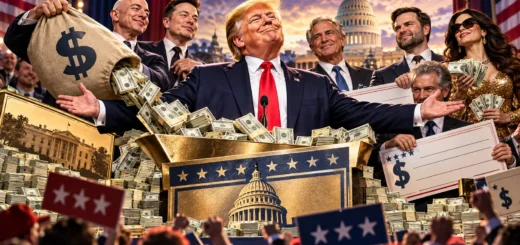
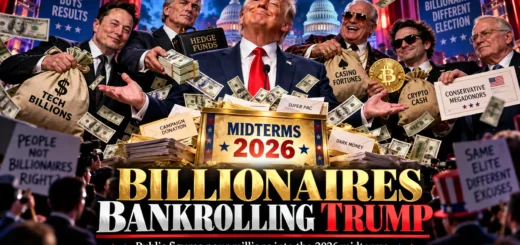
Donald Trump isn’t on the ballot this November, but America’s wealthiest political donors are pouring extraordinary sums into the battle over his presidency. From Elon Musk to cryptocurrency billionaires, the 2026 midterms have become a spectacular demonstration of how much money the ultra-rich are willing to spend on political influence.
The United States likes to celebrate democracy as government by the people. Yet the financial machinery behind the 2026 midterm elections offers a somewhat different spectacle: billionaires writing enormous checks while ordinary Americans debate grocery prices.
According to a September 22 analysis by The Washington Post of Federal Election Commission records, the 50 largest political donors and donor organizations had contributed approximately $1.78 billion during the election cycle.
Of that money, approximately $1.07 billion came from Republican-aligned donors, compared with $454 million from Democratic-aligned donors and $248 million from special-interest and bipartisan sources.
And at the center of the Republican fundraising operation stands Donald Trump, a president who has spent years portraying himself as a champion of ordinary Americans while benefiting from an exceptionally wealthy network of political supporters.
Meet the wealthy donors financing Trump’s political movement
Figures reflect reported large political contributions during the 2026 election cycle, as compiled by The Washington Post on September 22. They include donations to Republican organizations and issue-focused committees, not exclusively Trump-controlled groups.

Elon Musk
$90.6 million
Tesla and SpaceX’s chief executive contributed approximately $50.3 million to America PAC, alongside $10 million each to the Congressional Leadership Fund and Senate Leadership Fund, organizations supporting Republican candidates.

Miriam Adelson
$67.6 million
The casino investor and longtime Trump supporter gave $25 million to MAGA Inc., $30 million to Senate Leadership Fund, and $10 million to Congressional Leadership Fund.

Jeff Yass and Janine Yass
$95.3 million
Their contributions include $20 million supporting Vivek Ramaswamy, $17.5 million for school-choice advocacy and $16.5 million to Club for Growth Action. Their money supports conservative causes and Republican candidates, not solely Trump’s political operation.

Marc Andreessen and Ben Horowitz
$91.3 million
The venture capitalists’ reported contributions include $50 million to an artificial-intelligence-focused super PAC, $23.8 million to the cryptocurrency-focused Fairshake and $12 million to MAGA Inc.

Cameron Winklevoss and Tyler Winklevoss
$55.1 million
The cryptocurrency entrepreneurs gave approximately $21 million to MAGA Inc. and $21.3 million to the pro-cryptocurrency Digital Freedom Fund, among other contributions.
Other major Republican donors include Uline owners Richard and Elizabeth Uihlein, whose reported contributions reached $70 million, and hedge-fund billionaire Paul Singer, with approximately $53.2 million. Their spending supports a variety of conservative candidates and committees.
MAGA Inc.: The financial engine behind Trump’s influence
Among the most important organizations in Trump’s political orbit is Make America Great Again Inc., commonly known as MAGA Inc.
According to FactCheck.org’s October 6 review, the super PAC held approximately $415.8 million in cash as of August 31, 2026, after spending around $32.4 million during the cycle.
Trump said in September that he expected the organization to allocate roughly $400 million to $500 million toward helping Republicans in the midterms, although he also indicated that some resources could be retained for 2028.
For Trump, that money represents an opportunity to influence congressional elections without appearing on the ballot himself.
For the donors, it creates an opportunity to help elect lawmakers whose legislative priorities may align with their interests.
Of course, the latter does not establish that any individual donor purchased a policy decision. Political contributions are evidence of financial support, not automatically evidence of corruption.
But when a single donor can spend more on political advocacy than thousands of ordinary voters earn collectively in a lifetime, questions about democratic equality become difficult to dismiss.
What do the billionaires want?
The donors funding Republican candidates are not a single ideological bloc.
Technology investors have backed organizations focused on artificial intelligence and cryptocurrency regulation. School-choice advocates have financed committees promoting education policy changes. Other contributors prioritize taxation, economic regulation, judicial elections or conservative social policy.
Some supporters argue that such spending is a legitimate exercise of political speech and helps communicate policy priorities to voters.
Critics counter that unlimited outside spending gives extremely wealthy contributors disproportionate influence over political debate and potentially greater access to elected officials.
Both concerns matter, particularly when political advertising can overwhelm local campaigns and turn congressional elections into national battles over the president.
And this isn’t exclusively a Republican phenomenon
Wealthy donors also support Democrats.
George Soros-linked organizations contributed approximately $102 million during the cycle, according to the September Washington Post analysis. Democratic-aligned organizations such as House Majority Forward have also made substantial contributions to election-related committees.
That distinction is important. America’s dependence on wealthy political benefactors is a broader structural issue, even though Republican-aligned donors accounted for a substantially larger share of the money in the cited analysis.
The election is November 3. The money is already flowing.
The 2026 congressional midterms take place on Tuesday, November 3, when voters will elect the entire House of Representatives and approximately one-third of the Senate.
The outcome will determine which party controls Congress during the final two years of Trump’s current presidential term.
Meanwhile, a Reuters report published October 7 found that numerous Republican candidates in competitive districts were distancing themselves from Trump on particular policy issues, even as Trump-aligned organizations continued spending to support Republicans.
That contradiction captures the unusual political landscape: candidates seeking independence from a president whose fundraising network may simultaneously help their campaigns.
Conclusion: Democracy shouldn’t require a billionaire sponsor
The 2026 midterms reveal a fundamental tension in American politics.
Candidates need resources to communicate with voters. Donors have a legal right to support political causes. Yet the ability of a handful of wealthy individuals to deploy hundreds of millions of dollars raises legitimate questions about representation, transparency and accountability.
Trump’s political brand has repeatedly emphasized ordinary Americans and opposition to powerful establishments. His reliance on billionaire-funded organizations deserves scrutiny against that messaging.
The most important question is not whether wealthy people should be prohibited from participating in politics. It is whether the financial influence available to the exceptionally wealthy leaves enough room for ordinary citizens to be heard.
After all, every eligible voter gets one vote. The advertising budgets surrounding those votes are considerably less equal.